South to Kabelvag - the ancient capital of the Lofotens...
Day 60: Thursday 9th July, 2026
Tengelfjorden to Kabelvaag
Duration: 5.5 hours
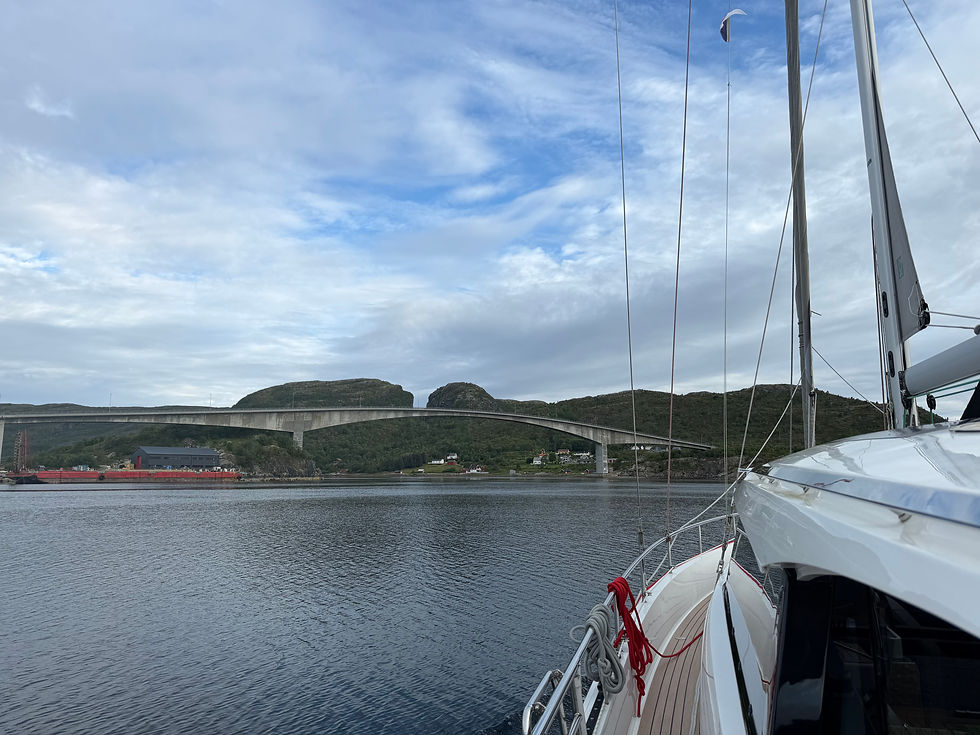
After a unforecasted rainy night, we were up early to catch the high tide and make our way back down Raftsund... then south along the rather bouncy Oybellesund...


Even without the sun, the peaks of the Lofotens are both beautiful and impressive, which is lucky as there is not much sign of the bright thing in the sky for the days ahead!
As we pulled into Svolvaer - the capital of the Lofoten Islands - we realized there weren't any free berths, so with a swift turn of the wheel we carried on Southwest ...

...and a short distance down the coast took a look at Kabelvag - the original Viking capital of the Lofotens (and the first settlement in Norway to be granted town status) - and happily found space on the small harbour pontoon ...


...Safely tied up, and knowing tomorrow was going to be a wash out, we decided to get the bikes out, and cycle the 5km to explore Svolvaer...passing the impressive Vagan church - built in 1898 to accommodate the hundreds of visiting fishermen - it is Norway's second largest wooden church and fisherman have priority for the pews...

...Svolvaer itself is the largest town in the Lofoten archipelago with a population of around 5,000 residents. Situated on the island of Austvagoya, it is seen as the Capital of the region and acts as a gateway to the rest of the islands having its own small airport and is a primary stop for the Hurtigruten coastal express ferry.
As we cycled into the town's harbour area, we could see it successfully blended the historical and modern fishing industry with Arctic tourism, with its traditional red fishermen huts called 'rorbuer' lining the harbour and busy bars, cafes and galleries full of tourists...


...The massive 'hjell' - the wooden A-frame Arctic cod-drying racks, sitting proudly in the distance on the breakwater wall..where the 'skrei'/cod are dried and transformed by nature in an ancient, zero-waste process into stockfish... the 'catch and hang' season runs from February through to April, where the gutted and paired cod are hung by their tied tails to dry in the crisp coastal winds. Once 75% of their water content has evaporated they are taken down and moved indoors for the 'maturation period' - another 2-3 months to mature and sort...and then sold.
The skrei dramatically changed the fortunes of Norway in the late 1800s and early 1900s as the protein rich dried food could be transported great distances to southern Europe where demand skyrocketed. During the peak years, over 20,000 fishermen descended on the Lofotens during winter hoping to make their fortunes by hauling up to 25 million arctic cod annually from the surrounding spawning grounds. With the advance of modern fishing methods a collapse in stocks took place, and a total ban of fishing cod was brought in by the 1980s. This has been loosened somewhat in recent years.

...after a nice amble round town we hopped back on the bikes and cycled back to the boat and arrived slightly more soggy and windswept ...

...so a quick trip to the supermarket to stock up on some hearty curry ingredients for the chilly damp days ahead.


Comments